Utah Greenlights AI Chatbot to Prescribe Psychiatric Drugs in Landmark One-Year Pilot
SALT LAKE CITY — In a move that has ignited intense debate across the intersection of technology and medicine, Utah state officials have authorized a pioneering one-year pilot program allowing an artificial intelligence chatbot to renew prescriptions for certain psychiatric medications without direct, real-time doctor oversight. This makes Utah only the second state in the nation, and the country as a whole, to delegate such significant clinical decision-making authority to an AI system.
The pilot, announced last week, focuses on renewing “certain prescriptions for psychiatric medications, in some cases,” primarily for existing patients who are stable on their treatment regimen. The system is designed to identify patients who meet specific criteria for a automated refill, bypassing the traditional bureaucratic process that often contributes to care bottlenecks and patient frustration.
The Problem: Bridging the Care Gap
Utah, like many states, faces a critical shortage of mental healthcare providers, particularly psychiatrists, resulting in long wait times for appointments and limited access to care in rural areas. Proponents of the pilot argue that the AI chatbot could significantly alleviate this strain.
“The demand for mental healthcare consistently outpaces our existing infrastructure,” said a spokesperson for the Utah Department of Health and Human Services (DHHS). “By leveraging advanced AI for routine administrative tasks like stable medication refills, we can potentially free up crucial clinician time to focus on complex cases and new patient intakes, ultimately improving access for everyone.”
The Solution (and Controversy): The AI ‘Gatekeeper’
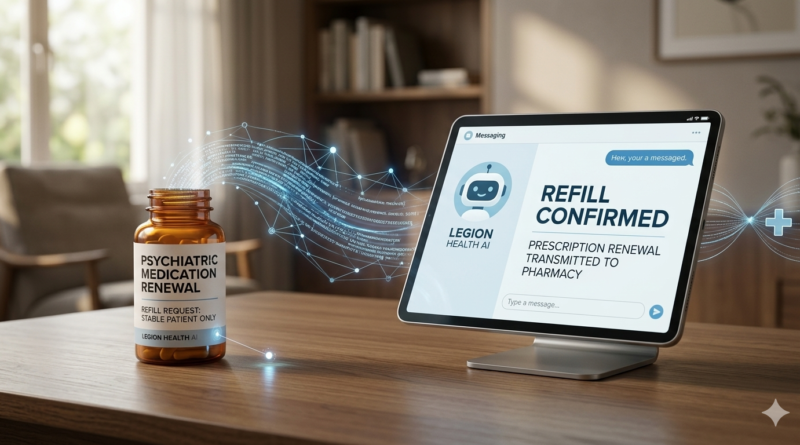
The chosen system, developed by Legion Health, a San Francisco-based startup, promises Utah patients “fast, simple refills” through an app-based interface and a $19-a-month subscription model. The AI chatbot interacts with patients, collects information about their current symptoms and stability, and—if the criteria are met—generates a prescription renewal that is electronically transmitted to their pharmacy.
Legion Health emphasizes that its AI is not diagnosing new conditions or initiating new treatments. It acts as an advanced, logic-based gateway for established treatment plans.
However, the medical community is deeply skeptical. The Utah Medical Association (UMA) and the Utah Psychiatric Association (UPA) have raised urgent concerns regarding the system’s safety, transparency, and ethical implications.
“Psychiatric medication management is complex,” stated Dr. Sarah Jenkins, president of the UPA. “It requires clinical nuance, the ability to assess subtle changes in a patient’s mental state, and an understanding of potential drug interactions and side effects that an AI, however sophisticated, cannot replicate. We are deeply concerned about the lack of human-in-the-loop oversight for what are often potent medications.”
‘Black Box’ Warnings: Risk vs. Reward
The central points of contention are:
-
Opacity: Critics argue that the algorithms guiding the AI’s decisions are proprietary “black boxes,” making it impossible for independent medical boards or the public to audit how the system makes critical clinical calls.
-
Risk: Physicians warn that stable patients can destabilize, sometimes rapidly. An AI might miss critical warning signs that a human clinician would detect through conversation or non-verbal cues.
-
Equity: Questions persist about whether this system will actually expand care to the most vulnerable populations or simply create a two-tiered system where those who can afford the subscription get faster service, leaving the underserved to wait for overburdened human doctors.
State officials, however, remain optimistic that the rigid parameters of the pilot and ongoing monitoring by the DHHS will mitigate these risks. “This is a controlled, observable experiment,” the DHHS statement continued. “We are watching the data closely.”
The outcome of Utah’s one-year pilot is expected to set a major precedent for the integration of autonomous AI in specialized clinical settings across the United States.